
Pre-Listing Inspection
The same comprehensive inspection a buyer would order, on your timeline, so you can fix, disclose or price findings before they trigger contingency negotiations.
A buyer-grade inspection on your timeline, before buyers find the issues.

A buyer inspection, run on your schedule.
Same scope, different audience. The report is written for the decisions a seller actually has to make.
Full home inspection
The same core scope as a buyer inspection, covering the major visible systems and components.
The same core scope as a buyer inspection, covering the major visible systems.
Seller priority report
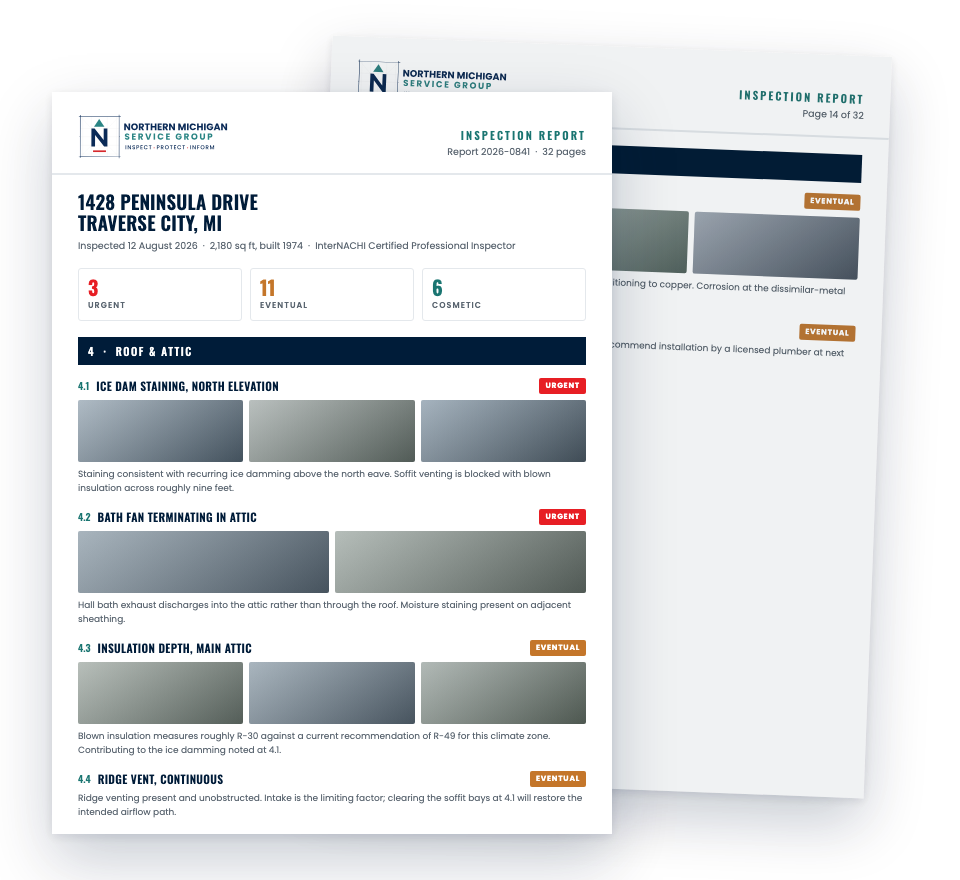
Findings organized into urgent, eventual and cosmetic decisions rather than a raw defect list.
Repair decision support
Which items are worth correcting before photography, and which are better handled through disclosure.
Which items to fix before photos, and which to disclose instead.
Fix it. Disclose it. Or price it.
The advantage is deciding before the buyer does.
Every finding falls into one of three responses. Knowing which one applies before the contingency clock starts is the entire point.
Fix It
Removes easy buyer objections and improves the first impression before a single showing.
Disclose It
You control the story instead of the buyer’s inspector introducing last-minute surprises.
Price It
Reflect it in listing strategy rather than negotiating it under contingency pressure.
Seller packages: Choose your level of readiness.
Municipal and rural properties attract different buyer add-ons. Resolve the likely ones before they become negotiation items.
Municipal and rural homes draw different buyer add-ons. Resolve them before they become negotiation items.
Swipe to compare →
Pre-Listing Inspection
- Full home inspection
- Same-day seller findings report
- Inspector available for any questions
- Full home inspection
- Same-day seller report
- Inspector follow-up
Home Inspection – Municipal
- Pre-listing inspection
- Radon testing
- Sewer scope
Home Inspection – Rural
- Pre-listing inspection
- Radon testing
- Septic inspection
- Well and water testing
Why it helps a listing
A buyer’s inspection happens on the buyer’s schedule, with the buyer’s contractor, under a deadline. A pre-listing inspection happens on yours.
A buyer’s inspection runs on their schedule and deadline. A pre-listing inspection runs on yours.
Control the timeline
Schedule repairs before photography and before a buyer’s contingency starts.
Control the contractor
Choose the vendor and the scope yourself, rather than having a buyer dictate terms.
Control the disclosure
Known conditions get disclosed and positioned clearly instead of arriving as a surprise.
Control the negotiation
A buyer can still inspect. The difference is that the major issues are no longer unexpected.
A report written for decisions, not just defects.
Decision-ready reports.
Readable photographs, findings grouped by priority, and a clear separation between what to address now and what belongs in a disclosure conversation. Delivered the same day so repair scheduling can start immediately.
Clear photos and findings grouped by priority, separating what to fix now from what to disclose. Delivered same day.
- Priority categories, not an undifferentiated list
- Photographs a contractor can quote from
- Same-day delivery
- Findings grouped by priority
- Photos a contractor can quote from
- Same-day delivery
Frequently asked questions.
How is this inspection different from a buyer inspection?
The inspection itself is the same. The difference is timing and audience. You receive the findings before a buyer does, with enough runway to act on them, and the report is organized around what a seller should fix, disclose or price.
Do I have to disclose what the inspection finds?
Michigan sellers complete a disclosure statement, and known material conditions generally belong on it. What counts as material, and how it should be worded, is a legal question specific to your transaction, so confirm your obligations with your listing agent or a real estate attorney. We provide the findings; the disclosure decision is yours to make with proper advice.
Can I share the report with buyers?
Yes, and many sellers do. It signals confidence and can shorten the contingency period. Buyers may still want their own inspection, which is normal.
Should I fix everything before listing?
No. Fix the cheap, visible and safety-related items. For material items that are not practical to fix, disclosure or price adjustment is usually the better route. Spending on a major capital item right before selling it rarely returns what it costs.
What is different for sellers?
The inspection itself is the same. The difference is timing and audience. You receive the findings before a buyer does, with enough runway to act on them, and the report is organized around what a seller should fix, disclose or price.
Must I disclose the findings?
Michigan sellers complete a disclosure statement, and known material conditions generally belong on it. What counts as material, and how it should be worded, is a legal question specific to your transaction, so confirm your obligations with your listing agent or a real estate attorney. We provide the findings; the disclosure decision is yours to make with proper advice.
Can buyers see the report?
Yes, and many sellers do. It signals confidence and can shorten the contingency period. Buyers may still want their own inspection, which is normal.
Should I fix everything first?
No. Fix the cheap, visible and safety-related items. For material items that are not practical to fix, disclosure or price adjustment is usually the better route. Spending on a major capital item right before selling it rarely returns what it costs.
How far before listing should I schedule it?
Three to six weeks is comfortable. That leaves time for repair quotes, the work itself, and photography afterward. Two weeks still works, but it narrows what you can realistically address.
Should I add radon or sewer or septic testing?
On a municipal property, radon and a sewer scope are the two things buyers add most often. On a rural property it is radon, septic and water. Testing them first means you are not learning the results during a negotiation.
Does a pre-listing inspection stop the buyer from inspecting?
No, and it is not meant to. Buyers will still order their own inspection. The goal is that nothing significant in it comes as a surprise to you.
When should I schedule it?
Three to six weeks is comfortable. That leaves time for repair quotes, the work itself, and photography afterward. Two weeks still works, but it narrows what you can realistically address.
Should I add other tests?
On a municipal property, radon and a sewer scope are the two things buyers add most often. On a rural property it is radon, septic and water. Testing them first means you are not learning the results during a negotiation.
Can buyers still inspect?
No, and it is not meant to. Buyers will still order their own inspection. The goal is that nothing significant in it comes as a surprise to you.
Go to market with fewer surprises.
See the house the way a buyer’s inspector will see it, then decide what to fix, disclose or price before the listing goes live.